Fit Call
Decide whether there is a meaningful operational leak: structural, expensive, repeated, and fixable.
Free
Book a fit callEngagements
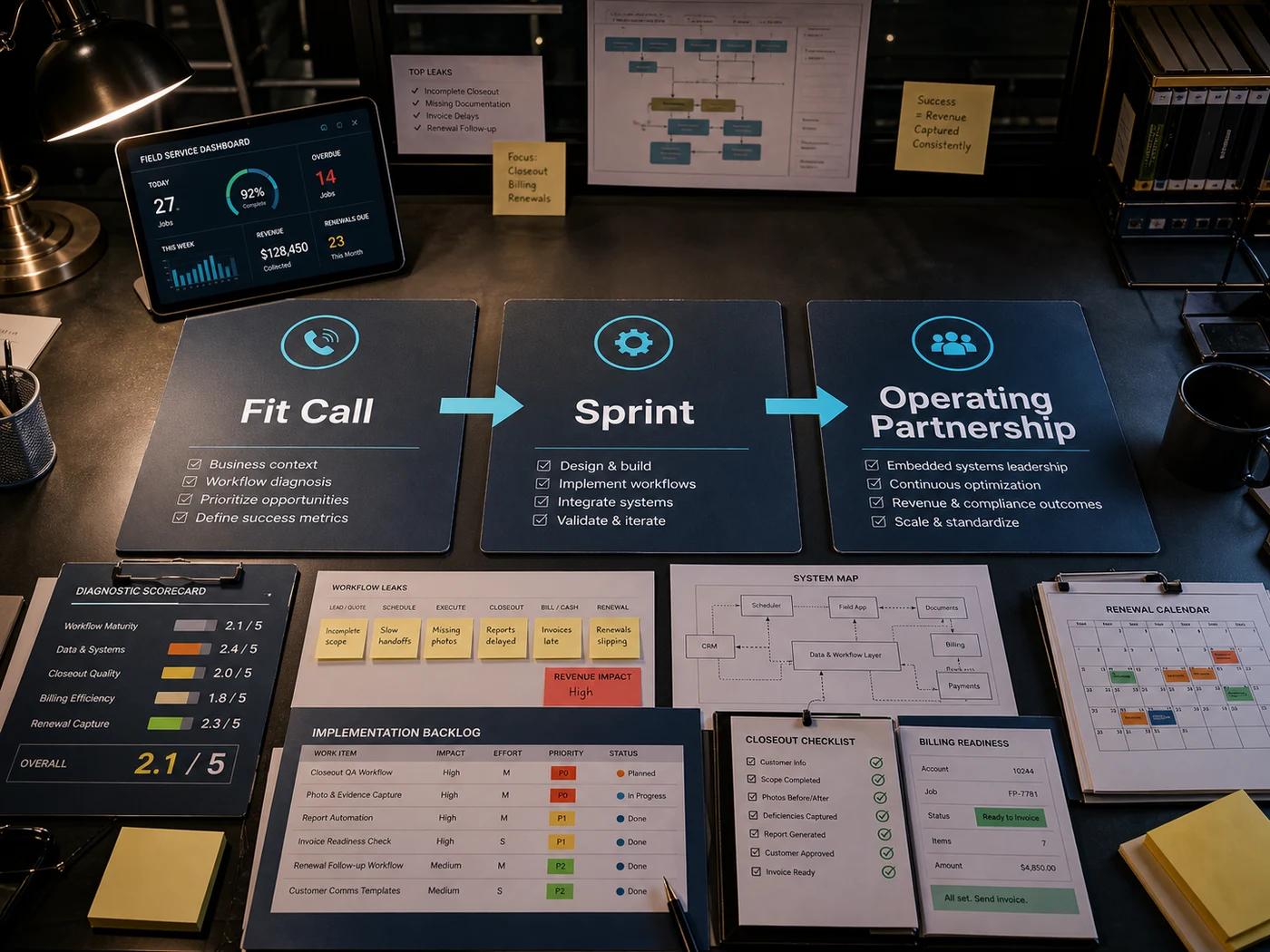
Most clients start with a focused sprint to diagnose and fix one expensive workflow leak. If the work reveals a larger systems opportunity, we continue as an embedded operating-systems partner.
Fit Call > Sprint > Operating Partnership
Decide whether there is a meaningful operational leak: structural, expensive, repeated, and fixable.
Free
Book a fit callDiagnose and fix one high-value workflow across field work, closeout, documentation, billing, or recurring due work.
Starts at $25k-$40k
Ongoing systems leadership and implementation across recurring work, closeout, reporting, billing, and workflow reliability.
Starts at $12k-$20k/month
Engagement 1
A short call to determine whether the problem is structural, expensive, repeated, and fixable.
We look for
Outcome
A clear fit decision and the most likely next step.
Book a fit callEngagement 2
30-45 day focused fix
A 30-45 day engagement to identify and fix one high-value workflow bottleneck.
Typical sprint focus
Deliverables
Engagement 3
Ongoing operating-systems partnership
For operators with multiple teams, branches, service lines, or recurring compliance obligations that need continuous improvement across recurring work, closeout, reporting, billing, and workflow reliability.
Engagement 4
Monitoring, optimization, and release cadence
For clients who have already implemented core workflows and need ongoing monitoring, optimization, and reliability.
Best Fit
Not A Fit
How To Get Started
We look for one expensive workflow leak first. If the opportunity is real, the first paid engagement fixes a business problem instead of producing a shelfware audit.